
 |
|||||||
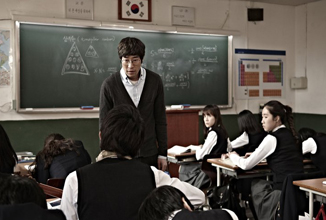
Synopsis: Seok-go (Ryoo Seung-beom) is a quiet and seemingly unassuming maths teacher living alone in a Seoul apartment block. Deeply enamoured with his neighbour, Hwa-seon (Lee Yo-won), he visits the cafe where she works each lunchtime without fail - always ordering the same takeaway food - but, try as he might, his shyness repeatedly prevents him from connecting with her on an emotional level; managing only an almost embarrassed 'hello' and 'thank you' he walks away frustrated and unfulfilled on each occasion.
Review: What would you be prepared to do for love? More than that, if someone told you they "did it for love" would you assume they meant love for someone or love from someone?
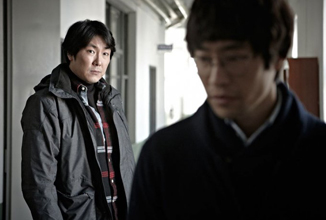
More than once during the course of the film, reference is made to a classical mathematical theorem that Seok-go has been obsessed with trying to prove since his school days. However, in helping Hwa-seon hide her crime his focus increasingly shifts from a sole preoccupation with the concept of a Perfect Number to a deep-rooted intellectual and emotional need to maintain her alibi and thereby create the perfect murder. This is added to yet further by the third piece in the character puzzle; that of Min-beom (Jo Jin-woong), the police detective in charge of the case who is also an old school friend of Seok-go: Ultimately, for all his intelligence Seok-go is set to find an answer he didn't even know he was looking for... the answer to the question "In a battle between heart and mind, which will win?"
Terms Of Endearment(1983) DirectWhat truly elevates Terms of Endearment is its fearless shift in tone during the final act. For much of its runtime, the film plays like a sophisticated comedy of manners and a sprawling family saga. However, when Emma is diagnosed with terminal cancer, the narrative pivots into a raw, heartbreaking exploration of grief and mortality. This transition never feels manipulative or unearned; rather, it feels as sudden and unfair as tragedy does in real life. The hospital scenes are handled with a rare, devastating honesty. Aurora’s fierce, desperate love for her daughter culminates in a famous, heart-wrenching scene where she demands pain medication for Emma, stripping away all her previous vanity to reveal a mother's raw, agonizing soul. Ultimately, Terms of Endearment is a masterpiece because it refuses to simplify human relationships. It shows that love is not a static, perfect emotion, but a verb practiced through endurance, forgiveness, and presence. James L. Brooks crafted a film that mirrors the duality of the human experience—reminding audiences that life can be hilariously absurd in one moment and profoundly tragic the next. Decades after its release, the film remains a touchstone of emotional storytelling, proving that the terms of endearment we share with those closest to us are the very things that define our lives. Terms of Endearment(1983) The film's narrative strength is further bolstered by its rich array of supporting characters, each bringing distinct flavors of humor and humanity to the story. Jack Nicholson delivers an Oscar-winning performance as Garrett Breedlove, a retired astronaut and Aurora’s hard-drinking, womanizing neighbor. The romantic subplot between the rigid Aurora and the wild Garrett provides some of the film's most electric and comedic sequences, showcasing two fiercely independent people terrifyingly yielding to vulnerability. Meanwhile, Emma’s marriage to Flap Horton reveals the slow, painful dissolution of youthful idealism, marked by infidelity, financial strain, and the heavy burdens of parenthood. What truly elevates Terms of Endearment is its Released in 1983 and directed by James L. Brooks, Terms of Endearment stands as a monumental achievement in American cinema, blending sharp comedy with profound tragedy to explore the intricate, often turbulent bonds of family. Adapted from Larry McMurtry’s novel, the film defies rigid genre classification. It oscillates seamlessly between witty, character-driven humor and devastating melodrama. By focusing on the lifelong relationship between a domineering mother and her free-spirited daughter, the film captures the messy, unpredictable reality of unconditional love, cementing its status as a timeless classic that resonates across generations. Ultimately, Terms of Endearment is a masterpiece because At the heart of the film is the magnetic and complex relationship between Aurora Greenway and her daughter, Emma. Aurora is a fiercely protective, demanding, and often difficult matriarch who expresses her love through control and high expectations. Emma, in contrast, is rebellious yet deeply affectionate, seeking her own path by marrying a man her mother intensely dislikes. Brooks brilliantly captures the push-and-pull dynamic of their bond. They fight, they judge each other, and they go periods without speaking, yet they remain tethered by an unbreakable emotional cord. Their daily phone calls serve as the film's heartbeat, illustrating that intimacy is often forged in the mundane, consistent sharing of life's small moments. DVD The DVD edition reviewed here is the Korean (Region 3) Art Service Limited Edition First Press version. The film itself is provided as an anamorphic transfer with an aspect ratio of 2.35:1 and there are no image artifacts (and no ghosting) present.
'Perfect Number'
- Commentary by director Bang Eun-jin, Ryoo Seung-beom and Jo Jin-woong
|
|||||||
All images © Art Service Review © Paul Quinn |
|||||||